
A properly maintained mechanical drive line ensures your exhaust fan spins at the correct RPM to maintain continuous, safe airflow. Slacking belts cause slippage, reducing booth ventilation, while over-tightened belts accelerate bearing failure. Follow these technical procedures to adjust, replace, and align your booth’s V-belt drive components.
Section 1: Pre-Service Safety & Lockout
Before performing any service on pulleys or drive lines, you must ensure the machinery cannot move:
Lockout/Tagout (LOTO): Shut off and padlock the main electrical disconnect switch for the exhaust fan motor at the control panel. Tag the switch to prevent accidental activation.
Isolate Mechanical Movement: Ensure the fan blades have completely stopped spinning before removing the belt guard.
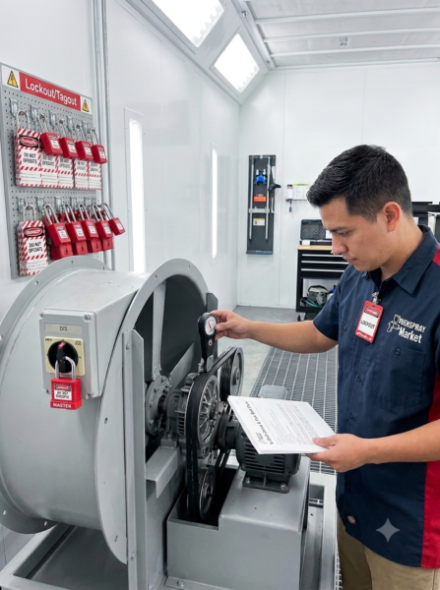
Section 2: Fan Belt Tension Adjustments
Proper belt tension ensures efficient power transfer from the motor to the fan shaft.
Remove the Belt Guard: Unbolt and set aside the protective mesh belt guard enclosing the pulleys.
Measure Deflection: Apply firm pressure to the center of the belt span (midway between the motor and fan pulleys). A correctly tensioned belt should deflect exactly 1/64 of an inch for every inch of span length under moderate thumb pressure (typically yielding roughly $1/2$ to $3/4$ inch of total deflection).
Adjusting the Motor Base: If the belt is too loose or too tight, locate the take-up adjustment bolts on the adjustable motor mounting base.
Loosen the motor chassis mounting bolts.
Turn the take-up jackscrews to slide the motor backward (to tighten) or forward (to loosen).
Lock It Down: Once optimal deflection is reached, re-tighten the motor chassis bolts firmly to prevent the motor from shifting under the high torque of startup.
Section 3: Replacing Worn Fan Belts
Belts are wear items that degrade due to friction, heat, and age. Replace the drive belt immediately if you observe glazing, cracking, fraying, or separation of the outer fabric layer.
Slacken the Drive Line: Loosen the take-up adjustment bolts on the motor base and slide the motor fully forward toward the fan shaft. This relieves all tension, allowing the belt to slacken completely.
Remove the Old Belt: Slip the loose belt off the larger fan pulley first, then lift it away from the smaller motor pulley. Never pry a tight belt off a pulley with a screwdriver or crowbar, as this will warp the pulley sheaves and ruin the alignment.
Inspect the Pulley Grooves (Sheaves): Before installing the new belt, wipe down the pulley grooves with a clean cloth. Inspect for heavy overspray deposits, deep ruts, or ridging inside the side walls. Rough or worn grooves will shred a new belt within weeks.
Install the New Belt: Slip the fresh belt over the motor pulley first, then gently guide it into the fan pulley groove by hand.
Set Initial Tension: Adjust the motor base backward until proper deflection is achieved as outlined in Section 2.
The 48-Hour Run-In Check: New V-belts will stretch slightly during their first few hours of continuous operation. Re-check and re-tighten the belt tension after 48 hours of spraying to compensate for this initial seating period.
Section 4: V-Belt Pulley Drive Alignment
Misaligned pulleys cause the drive belt to twist, generating extreme friction heat, rapid belt wear, and severe fan vibration. The faces of the motor pulley and the fan pulley must sit perfectly parallel.
The Alignment Verification: Place a precision machined straightedge across the outer faces of both pulleys. Alternatively, stretch a heavy-duty alignment string taut across the centers of the two shafts.
Identify the Misalignment: * Angular Misalignment: The shafts are not parallel, causing the straightedge to touch only certain edges of the pulleys.
Parallel Misalignment: The shafts are parallel, but the pulleys are offset along their respective shafts, preventing the string from laying flush across all four contact points.
Correcting the Setup:
To fix parallel offset: Loosen the set screws holding the pulley hub to its shaft. Carefully slide the pulley inward or outward along the keyway until it aligns perfectly with the opposing pulley. Re-tighten the set screws.
To fix angular offset: Adjust the position of the motor housing on its mounting base or shim the motor feet until the straightedge contacts all four edge points of both pulleys simultaneously.
Final Check: Manually rotate the drive system by hand a few turns to verify the belt tracks cleanly into the center of the grooves without riding up the side walls. Re-install the protective belt guard before restoring power.