
Proper drive belt alignment and precise tensioning are critical to maximizing the lifespan of your fan motor and preventing catastrophic belt slippage. While new belts are set correctly at installation, all V-belts stretch during their first few hours of operation. You must readjust belt tension after the first 8 hours of running, and check it again after 100 hours.
Step 1: Calculating Your Required Deflection
Never guess your belt tension. Use the structural formula provided by factory engineers:
Measure the exact span length (the distance between the center points of the motor sheave and the fan sheave).
Calculate your required deflection by multiplying that span length by 1/64.
Example: If your belt span length is 32 inches, your target deflection is precisely 1/2 inch ().
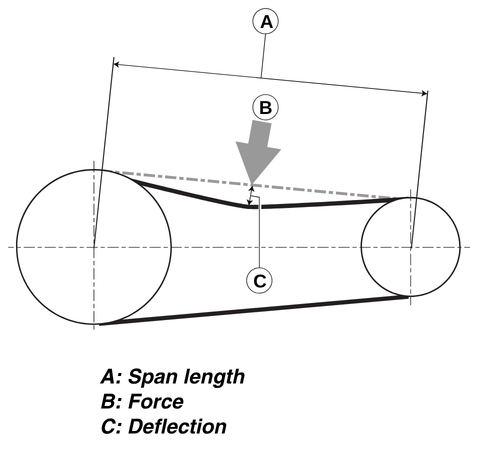
Step 2: Testing Deflection Force
The Test: Apply tension force evenly across the width of the belt at the exact midpoint of the span length. (Tip: Use a strip of keystock across the belt to distribute your pressure evenly).
The Target Specs: For a standard 5VX belt type, a new belt should require 18.9 to 23.4 pounds of force to achieve that deflection. A used, broken-in belt should require 11.2 to 15.5 pounds of force.
Adjustment Rule: If your measured deflection is greater than your calculated target under these weights, your belt is too loose and must be tensioned. Warning: Under-tightening causes belt slippage at start-up and uneven wear; over-tightening ruins bearings and causes excessive drive noise.
Step 3: Perfecting Sheave Alignment
If your motor and fan pulleys (sheaves) are misaligned, your belts will twist, vibrate, and wear down prematurely.
Axial Alignment: Ensure the fan and motor shafts are perfectly parallel in both the horizontal and vertical planes.
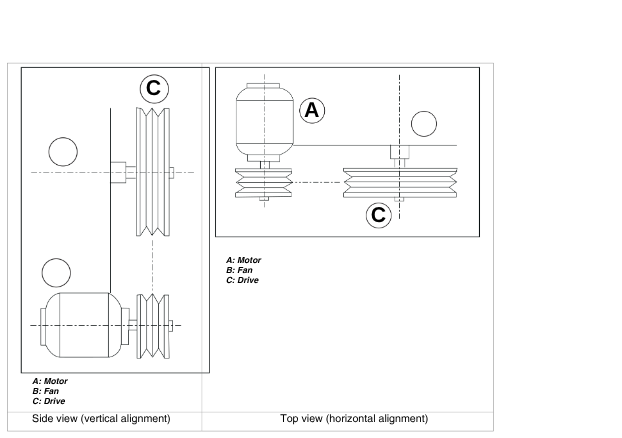
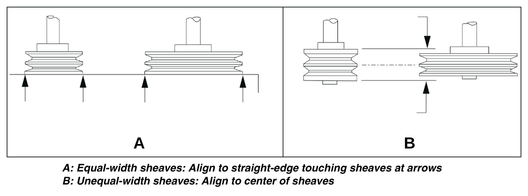
Radial Alignment:
If your sheaves are of equal width, press a straight-edge across the faces; it must touch all four designated alignment points cleanly.
If your sheaves are of unequal width, align them precisely to the center lines of the sheaves.
Multi-Groove Rule: When replacing belts on a multi-groove drive, you must always install them as a matched set. If one belt sits lower or bows out further than the other during operation, they are unmatched and will cause rapid drive failure.
Step 4: Replacing a Fan Belt
Isolate the machine via lockout/tagout.
Loosen the motor hold-down bolts and use the base adjusting jackscrew to slide the motor inward toward the fan.
Slip the worn belt off the sheaves.
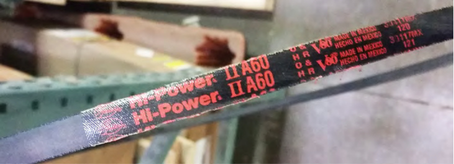
Check the stamped technical numbers on the old belt (e.g., Hi-Power II A60) and replace it with a belt matching that exact length and cross-section.
Adjust the motor outward, verify your sheave parallelism, and lock down the hold-down bolts securely.
V-Belt Drive Considerations
V-belt drives on GFS fans are purposely sized to handle considerably more load than would be necessary for normal drive design. This is done to prolong the life of the drive and provide for minimum maintenance. Belts should be replaced when they have obviously become worn, even though they are still operating. A badly worn belt will also cause undue sheave wear.
Replace belts when they show definite signs of wear; otherwise the sheaves will become worn to the point where they also must be replaced. Never put new belts on a badly worn sheave. This will reduce the capacity of the drive and cause excessive belt wear.
Most GFS fans are provided with an adjusting screw as a part of the motor base for easy setting of belt tension. However, small fans or fans using small horsepower motors may have only a slotted base plate.