
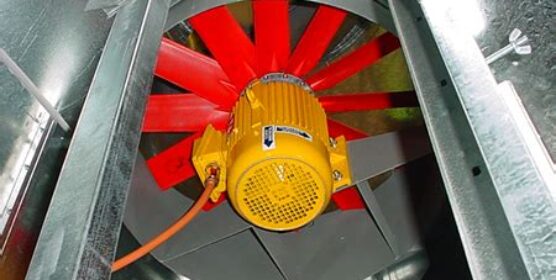
The exhaust fan assembly is the mechanical heart of your spray booth’s ventilation system. Allowing paint residue to accumulate on the blades or ignoring bearing wear restricts airflow, throws the fan out of balance, and can lead to costly motor failure or friction-induced fires. Follow this technical guide every month to keep your exhaust fan operating at peak efficiency.
Pre-Service Safety & Lockout Protocols
Before performing any physical inspection or maintenance on the exhaust fan housing, you must completely isolate the equipment from its power source:
Lockout/Tagout (LOTO): Shut off and padlock the main electrical disconnect switch for the exhaust fan motor at the control panel. Tag the switch to ensure no one can accidentally cycle the fan while your hands are near the assembly.
Allow to Cool: If the booth has an Air Make-Up Unit (AMU) or bake cycle, allow the exhaust housing and fan components to cool down fully before touching them.
PPE: Wear heavy gloves, safety glasses, and a particulate respirator to protect against disturbed paint flakes and grease.
Monthly Housing Clearance & Blade Inspection
Proper airflow relies on precise mechanical tolerances between the rotating fan blades and the stationary fan ring housing.
Check Blade-to-Ring Clearance: Use a flashlight to inspect the gap between the tips of the fan blades and the interior exhaust ring. This clearance must be uniform all the way around. If the fan shaft has shifted or the housing has warped, the blades may strike the ring, creating catastrophic friction sparks.
Inspect for Fan Blade Buildup: Examine both sides of each fan blade. Even a thin, uneven layer of hardened overspray acting as dead weight will destroy the factory balance of the assembly, causing severe system vibrations.
Look for Physical Damage: Check the blades for cracks, stress fractures, or deep pitting—especially near the center hub weldments. Damaged blades must be replaced immediately; never attempt to operate a fan with a compromised blade structure.
Bearing Play & Lubrication Evaluation
Worn bearings generate extreme heat and are a leading cause of industrial spray booth fires. Catching bearing wear early prevents complete shaft seizure.
Check for Radial and Axial Play: Grasp the fan shaft near the bearing block (ensure LOTO is active) and attempt to move it firmly up and down (radial) and back and forth (axial). There should be virtually no detectable mechanical play or slop. If you feel clunking or shifting, the bearings are failing and require immediate replacement.
Listen for Mechanical Noise: Manually rotate the fan blades by hand. The shaft should spin smoothly and quietly. Listen closely for any grinding, squeaking, or clicking noises that indicate dry or pitted ball bearings.
Inspect Bearing Seals: Look closely at the bearing housing seals for signs of grease leakage or overheating (such as blackened, burnt grease or discolored metal).
Lubrication Note: If your bearings are greaseable, apply a high-quality, manufacturer-specified lithium-base or high-temperature grease using a manual grease gun. Do not over-grease, as blowing out the bearing seals will allow sticky paint dust to enter the bearing race.
Fan Housing & Shroud Cleaning
The exhaust shroud and the area immediately surrounding the fan motor must be kept clean to ensure optimal motor cooling and unrestricted air movement.
Scrape the Shroud Housing: Use an aluminum, brass, or heavy plastic non-sparking scraper to peel away caked-on overspray from the interior walls of the fan ring and the support struts.
Vacuum Loose Debris: Utilize a certified explosion-proof vacuum cleaner to remove all loose paint flakes, dust clumps, and debris from the base of the fan stack and the motor mounting deck. Never let loose flakes settle around the motor cooling vents.
Clean the Motor Cooling Fins: Dust and overspray acts as an insulator on the electric motor housing. Wipe down the external cooling fins of the fan motor to ensure it can shed heat properly during high-production days.