
The product doors on your spray booth do more than just seal out dust—they are critical safety and pressure-containment mechanisms. If doors fail to seal tightly, unfiltered shop air can ruin paint jobs; if emergency latch releases or roll-up safety features fail, it puts operators at severe risk. Perform these functional checks every week to ensure complete operational safety.
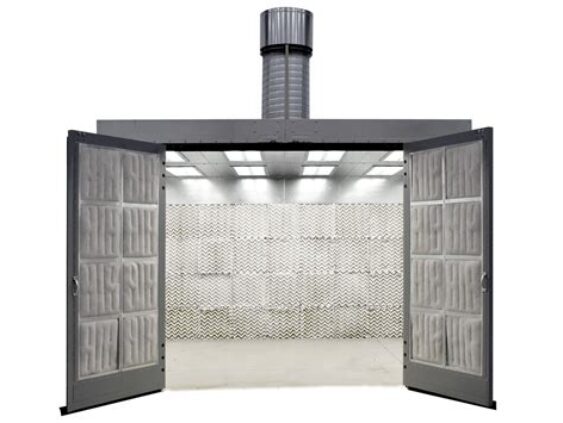
Standard Swing Doors (Latch & Seal Integrity)
Standard swing-style entry and product doors rely on uniform compression across their gaskets and positive-latching hardware to handle pressure fluctuations during operation.
1. Perimeter Gasket & Seal Inspection
Check for Compression Set: Walk the inner perimeter of the doors and inspect the rubber or foam gaskets. Look for sections that are permanently flattened, torn, brittle, or caked in dried overspray.
The “Dollar Bill” Test: Close the door on a slip of paper or a dollar bill. If you can pull the paper out easily with no resistance, the gasket is not compressing adequately at that spot. Adjust the door hinges or replace the gasket to restore the seal.
Eliminate Sagging: Inspect the heavy-duty hinges for physical wear or loose mounting bolts. A sagging door will misalign the perimeter seal and cause air leaks or binding during high-pressure booth cycles.
2. Latch Integrity & Pressure-Relief Testing
Verify Positive Latching: Ensure that slam-latches or friction rollers engage fully and smoothly when the door is pushed shut.
Emergency Escape Function: Spray booth latches are engineered to release under a specific amount of outward physical pressure (acting as an explosion relief mechanism or emergency egress). Test the inner emergency handles or push-bars to verify that a technician can effortlessly escape the booth if doors slam shut. Never padlock, chain, or block swing doors from the outside while the booth is in use.
Roll-Up Product Doors (Safety Edge & Interlock Testing)
Motorized roll-up doors introduce heavy mechanical moving parts to the booth entryways. They require a rigorous verification of their automated safety controls to prevent crushing injuries and equipment damage.
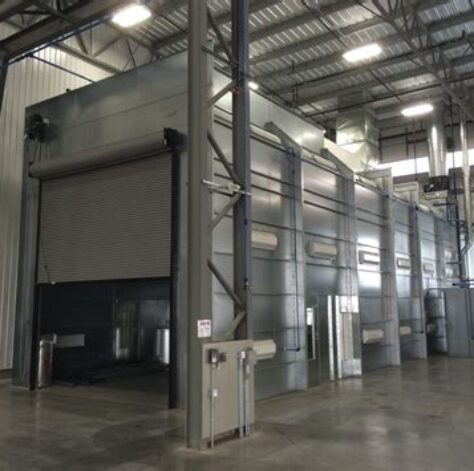
1. Safety Edge Bounce-Back Testing
Roll-up doors feature a sensitive pneumatic or electronic sensing edge along the bottom rubber seal. If this edge encounters an obstruction (like a vehicle bumper, a parts rack, or an operator), it must instantly reverse direction.
The Testing Protocol:
Initiate a downward cycle to close the roll-up door.
As the door descends, place a solid, inanimate object (such as a sturdy 2×4 block of wood) flat on the floor directly in its path. Never use your hands, feet, or body parts to test this mechanism.
Allow the bottom edge of the door to strike the block.
The Requirement: The door must immediately stop its downward travel and automatically reverse back into the fully open position upon contact. If the door pauses, crushes the object, or forces its way down, immediately lock out the door motor and call a service technician to recalibrate the sensitivity switch.
2. Limit Switch & Interlock Verification
Travel Limits: Watch the door run through a complete cycle. It should stop smoothly at its exact upper and lower limits without crashing into the header shroud or slamming hard into the concrete.
Fan Interlock Check: Most automated roll-up doors are electronically interlocked with the booth control panel. Verify that the exhaust and intake fans cannot engage unless the roll-up doors are completely lowered and locked into position. Conversely, verify that if a door is raised even slightly during a spray cycle, the spray gun air supply line immediately drops pressure to prevent overspray from escaping into the shop.